Wednesday, 4 November 2020

Language 1

Language is always poetic. Words, and the arrangement of words, evoke associations, first through their sound, their meaning, their typical environment, but then also through the personal experience attached to them. Written language is poetic, but its poetic associations are of course different from spoken language—e.g., visual impression and location create additional associations—, and spoken and heard language is dfiferent from each other. and, to repeat, all language encountered is poetic because it is experienced by individuals who, themselves, are poetic.

"Set", as used by mathematicians, has own sound, its associations (to drawings, to numbers, to proofs, to problems, to extra-mathematical concepts like a tennis set); "Menge", the corresponding German terms, shares many of those; but also has a direct association to many things. Getting rid of associations that are deemed irrelevant is difficult, and specialists try to do it with definitions; but ultimately only succeed with Wittgenstein II, i.e., by training the "right" language games over and over and over again. One helpful method is to coin new terms: "homomorphic" or "autopoiesis". But extending the usages to other areas cannot be prohibited, and thereby new associations emerge and sink into the minds of writers, readers, speakers, and listeners.

Establishing a regime that evaluates use of language in a discipline is therefore "necessary," i.e., it happens. "Autopoiesis" has been used in juridical contexts, but never in court language. Homomorphisms can be drawn over into philosophy, but the language of cattle raising does not allow to use it, until today. Of course, delineating "court language", "philosophy" or "talking about cattle" are, in itself, enterprises that include language, but this is "just so". Langugage games appear to converge almost always, i.e., people are happy with pvercome traditions, thoughts, and uses of words. Thus, boundary transgressions are typically easily recognized; and the desire for constructive interaction, custom and, maybe, laziness will be enough to prevent them. If not, an element of power will come in.

However, if an enterprise like philosophy draws significant breath of life from such transgressions, sanctioning of unwanted boundary transgressions requires even more, and, at places, mainly power. Life is so much more than language—it is earning a living, seeing oneself accepted, being attracted by things, event or poeple, having possibilities; all this can be shaped or even revoked by power. And so, language, ultimately, because it is poetic, is also shaped by power, even in contexts where power itself is not the main game and goal: Which is to say, everywhere.

Still, nothing new here.

Sunday, 1 November 2020

Rules 1

Humans can follow rules 100%—and they are the only animals capable of this. I do not (yet?) know why this is so; but it has something to do with what rules are, and what rules are about.

Take chess, as an example. A chess player, after having learned chess's rules—maybe as a child—, will always move a rook along rows or columns on the chess board when playing a game of chess. With someone playing 3 to maybe 20 games a day on average, that would make some 10 times 365 times 50 or almost 200,000 games: And most probably, the player will not slip on a single one of them. Even if a rook ends up in a wrong position one day, the opponent, or the player herself, will notive this, and the player will agree that the rule was different than what happened; and will correct the move.

Or take a writer, writing English texts in current times. He will write "the" always with these three letters. And even if he slips, he will agree if someone points it out; and correct it.

Here is a more complex story how ingrained rule-following is in humans. I live in Bavaria, near Munich, where we have a mass transit system covering about 5500 square kilometers, with integrated ticketing. On the line from Munich to Grafing, where I live, the ticketing border is jsut before Ostermünchen, from where the line continues to Rosenheim. This means that for a travel frm Munich to Grafing, you have to buy a transit ticket at a ticket vending machine; whereas if you travel to Ostermünchen or beyond, you can buy the ticket on the train. A regular ticket there is about 17 Euros, whereas the fee for travelling without a ticket anywhere in the transit system is 60 Euros.

One day, a lady jumps into the train just before its doors close. The conductor ask her for a ticket: In accented German, she tells her that being in a hurry, she couldn't get one a at the vending machine; could she now buy needs one to Grafing. The conductor explains that she cannot sell her a ticket to Grafing; this is only possible for destinations Ostermünchen and beyond. The lady insists that she needs to travel to Grafing. Again, the conductor explains the rules: "If you need a ticket to Ostermünchen, I can sell it to you; but not to Grafing". Again, the lady insists that she needs to go to Grafing. The conductor, with all of us listening, with a tiny shrug, tells her, that because of the lacking ticket, she has to fine her 60 Euros. The lady does not really understand what's going on; but after some discussion, she accepts that these are the rules—when, finally, another passenger interrupts: "Can't you sell her a ticket to Ostermünchen?" The conductor waits a little—then the lady says she does not want to go there. It is getting awkward. Again the passenger addresses the conductor—it is obvious the lady is overwhelmed: "Just sell her a ticket to Ostermünchen, please!" Without a pause, the conductor says: "Ok, I'll do this once for you. That would be 17 Euros." It appears very much that the lady still does not understand what's going on—but she now accepts that she has to go to Grafing with a ticket with destination Ostermünchen, costing her 17 Euros.

Obviously, the conductor did not want to bend the rules in front of all the other passengers: She had to adhere to what's written—travelling inside the transit system area without a ticket costs you 60 Euros; but she could sell tickets beyond the system's boundary. And, for what it's worth, also the lady could not bend the rules she had learned: If you want to go to destination X, you need to purchase a ticket to X. The "non-linearity" of these rules had led to a crash, hadn't the passengers been the catalyst that enabled an different reaction.

My initial thought was that the reason that we follow rules so perfectly is a social one: Playing together certain games requires following rules perfectly, otherwise games with many players, or with high stakes, or long-running games would quickly deteriorate and end. But much of our civilization seems to consist of such games.

But then I saw another lady sitting opposite me, doing a crossword puzzle. She followed the rules perfectly: Filling it out with wellknown German words that had identical letters at the crossing places, and were solutions to the hints given. Nobody forced her to do this. She could have written in any words she wanted, she could have stopped solving it: But no, she racked her brain to find one word after the other. So, it's not a social effect, or not a social effect alone. It seems that we have fun following rules: Solving a crossword, finding a mathematical proof to some unimportant formula, playing a piece of music exactly as it is written in the score.

How can we do that, and how can we agree that we do that (in some specific situation)?


Tuesday, 27 October 2020

Induction 4

 An old thought: The extension of a proposition, and therefore also an implication, is True or False. But who cares for extensions? It's intensions that count against an inductive hypothesis.

Abstraction 1

There are no circular objects in the real world, and no rectangular (of course, one can give a new definition of "circular" that includes some, probably mathematical rules. That's not what I mean here; I mean "circular" as used by common people, or by people from say 10000 B.C.). But of course, we can and do label some objects as being (or appearing) circular, or rectangular, like the sun as seen in the sky, or the basement of my house looked down from above. Is this labelling a language thing, or something pre-language? As far as I know, some animals can reliable distinguish circles from rectangles, so it's a pre-language thing. Might it, then, not be something in nature itself, i.e., is the sun's image on the sky circular?

Question: Are there sharply distinguishable things in nature? Yes, there are: Liquids and rigid bodies are "just different". Of course, there are things like hot wax that are somehow both or in-between. But that doesn't mean that there aren't many things that are liquid; or that are rigid.

Being circular gets more and more cloudy if one looks at more and more details. Being a liquid doesn't—down to a microscopic level beyond the reach of non-scietnific exploration, it is always clear whether a patch of something is liquid, or rather the rigid container of the liquid. Similar to the wax example, in some situations, this isn't true: Water in a puddle is usually not clearly separatable from the non-water mud. But again, in many, and many typical, situations, the boundary is absolutely clear. So nature itself can create sharp macroscopically and easily observable boundaries.

However, for the moment, I go with the assumption that this is a coincidence. There are many more natural boundaries that are hard to understand. We know now that on Earth, the boundary between life and non-life for easily observable objects is very specific: Life is that which is equipped with DNA and a working energy supply, non-life is all the rest. This was not clear for thousands of years. Still, life and non-life were clearly separated in thought and language.

And we know that many observable species are actually separated from each other perfectly, i.e., they cannot create offspring. But the reasons for this are quite intricate (and therefore, some different species can create common offspring that is of a third kind). But is interesting that while mice and rats had their distinct names at all times, other similarly distinct species got common names and were mixed up by most people and languages (examples missing here).

But, as I said, I consider the (many) obvious natural boundaries just an input to evolution. And leave the examination whether this is ok open = open question 1.

The next question, then, is: Are all abstractions omparable to those we share with other species; which would, for example, mean that they need only little rational thinking, and no language at all. Or are many abstractions, in their way of being, evolutions only of human thought? I would like to start from a stance that also abstractions that we humans share with some other species (like being circular) are a coincidence, i.e., that I can argue about all abstractions as if they were human-only (like being married, or being king). But I have not yet argued that this is the case = open question 2.

So, for abstractions that are human-only (or, as said above, all abstractions viewed as human-only): It's obviously not a language-thing: There are abstractions for certain dance patterns, and certain musical ideas, and certain mathematical counter-examples even before anyone has a word for the respective abstractions. Reading treatises on music theory even from the 18th century, and listening to even a simple piece of Mozart shows that language lagged behind the actual knowledge of composers about abstractions lagged by millions of miles, so-to-speak.

And writing down, or even discussing, in language thinking about abstractions creates its own paths of thought, because language is , on the whole metaphorical. So the abstractions found in written documents, and even in discussions, are a mixture of absurd and agreeable ones.

But how, then, can one usefully characterize abstractions, and humans' use of them?


Friday, 23 October 2020

Another, Not At All Original, Thought on Induction - Replace "Implies" With "Causes"


I don't really think the following works ... but: As another cure of the non-black-non-raven paradox, would it be possible to have a new logical operator "causes"? The difference to "implies" would be that no "ex falso quodlibet" would be allowed with "causes": A falsity cannot cause anything; and then of course the contrapositive would not work, and the pardox would vanish.

The truth table of "causes" would be interesting: "true causes true" could be both true or false, depending on whether the first truth actually causes the second. I wonder whether just leaving that open in propostional calculus still allows for some conclusions to be drawn; for at least "a causes b" and "b causes c" would have to imply "a causes c".

I am sure someone has already worked this through, and shown it to be problematical; and/or mapped it to some multi-valued logic, with corresponding results.

A Thought on Induction - the Non-Black-Non-Raven Paradox Might Not Be That Important

From pure propositional calculus, we of course have a → b ⇔ ¬b → ¬a. One of the problems with induction is the non-black-non-raven paradox: If we use, in an inductive reasoning process, an example of a black raven as "counting towards the consequence raven → black", then an example of a non-raven non-black thing should count towards the same conclusion—or should it? To me, this confuses the process of induction with the result of induction. Even if we assume the latter is the logical formula "∀ x: Raven(x) → Black(x)" (which is not at all clear: It might be that the result of induction is a form of weighted proposition, or an expectation, or a belief): Of course, from the result we can conclude "∀ x: ¬Black(x) → ¬Raven(x)"; but using the non-black non-raven example in the same way as the black raven is not at all required; and, I say, not even plausible. After all, this single example (or even a set of such examples) is no logical statement, but, at best, a ground instance of some as yet unclear logical statement(s). From the fact that we have an object 1 in the world that can be described as the combined proposition (non-raven1, non-black1) being true, we can trivially conclude that non-raven1 → non-black1 is true; as we can also conclude non-black1 → non-raven1, and, indeed, non-raven1: But all this, of course, does not tell us that all things are not ravens, or even that more than one thing is not a raven.

So my argument is: The input to "inductive reasoning process" (however that works) are facts; the output is some sort of (maybe nehanced) logical statement. And thus, the two are handled wildly differently.

Counterargument: Think about a sort of induction where the inputs are already logical statements (e.g. on subsets): Let's say we know that all A2 are B; and all A3 are B; and all A5 and all A7 and all A11 are B; etc. How does inductive reasoning let us conclude that all Ap, where p is prime, are B? If this is induction, then the "facts" above are just small logical assertions, e.g. "all raven1 are black" (there only being one raven1, but this is then a coincidence). It isnecessary to check whether this model of induction—which follows more closely deduction's black box, where both input and output are logical statements—is worthwhile to be studied

A Thought on Induction - Grue and Time

In some treatises on induction, time seems to be essential: Induction is presented as a process where, over time, more and more assertive examples are encountered, and therefore the inductive conclusion gets, in some way or the other, more and more certain. This underlies, it seems to be, for example Goodman's grue and bleen paradox.

Right now, I don't see why time is an essential and different property from all other properties. Induction is done on a set of examples: If I pull a hundred tiles from an urn containing thousands, and all rectangular are blue, then I could inductively assume that all rectangles are blue. Of course, this hinges on all those other aspects of induction that have to be discussed—but by itself, there is no need to pull the examples one after the other. But then, the grue problem disappears: If time is just another property of the input examples, either I pull only blue rectangles for t=now and t=then; and then the induction result is "rectangle implies blue". Or I pull blue rectangles for t=now and green ones for t=then, and then the result is "rectangle implies grue" (or was it bleen?).

Of course, there is at least one practical problems to sampling over different times: I cannot sample something from the future. But there are also many other sampling problems, and in scienes and humanities, we have to be inventive to get rid of these; whereas in practical life, we may just accept them and live with coarser inductive approximations. But this is not a problem of inductive reasoning per se. And one solution is always to go home for now and wait until t=then when we can sample better. So you might have to wait for a solar eclipse to get an example of what you are interested in.

Monday, 19 October 2020

"Induction is learning by love"

 "Love", here, is my word for something like "being very non-linearly controlled by recurring similiar events". The events are, first, seeing a loved person (or thing?) a few, and then many times; and then associating other events with them: Locations, smells, times, and, finally, thoughts. The "very non-linearity" means that there is no useful and somewhat precise model of the properties of the event (duration, distance, novelty, recentness, participants, ...) and the control effect: It might be that the seventh incident, from far away and at a remote nightly time creates heavy breathing and a huge burst of adrenaline; whereas a straight and near eighth encounter just makes oneself a little happier (whatever sort of control this is meant to be).

In other words: There is no reason that probability, in the sense of "frequency of combinatorial patterns", can be used to understand inductive reasoning, or inductive learning.

An inductively learning system needs to "blush" at, i.e. "exponentially" react to, every encounter of an interesting event, in order to include it into its experiences or storage.

I still assume that the "world" is slowly changing here, i.e., it is "Humean". Is this, in itself, something that must be factored out?


Friday, 5 May 2017

Never attribute to malice that which is adequately explained by stupidity, globally

(see Hanlon's razor).

It would be more or less great if climate change and bee dying were caused by malicious coal and pharma bosses who, Darth Vader-like, want to rule the world.

But then they would, in their intelligent malice, understand that are subverting their goals by killing off exactly the world they want to rule—if not for themselves, then for their children.

But they don't see it.

And my day-to-day experience with people has convinced me that even those who can and do think rationally in their selected field of expertise more or less completely fall back to their emotional instincts everywhere else—and this means stupidity.

What makes it even worse is that they themselves, by understanding their expertise, and by being praised by others, believe that they are rational over the "whole problem spectrum", so they are unable to become humble (which may be an example of Dunning-Kruger).

And therefore, they continue in their stupidity, which takes the world to be stable and unchanging everywhere, except where they intend to reshape it. But actually, they reshape all of our planet. And don't understand it. And will not understand it even when it crashes around them and on them and below them.

So, goodbye world.

Sunday, 2 April 2017

Die Epizykeltheorie - wie sie funktionieren sollte, aber leider nicht tut

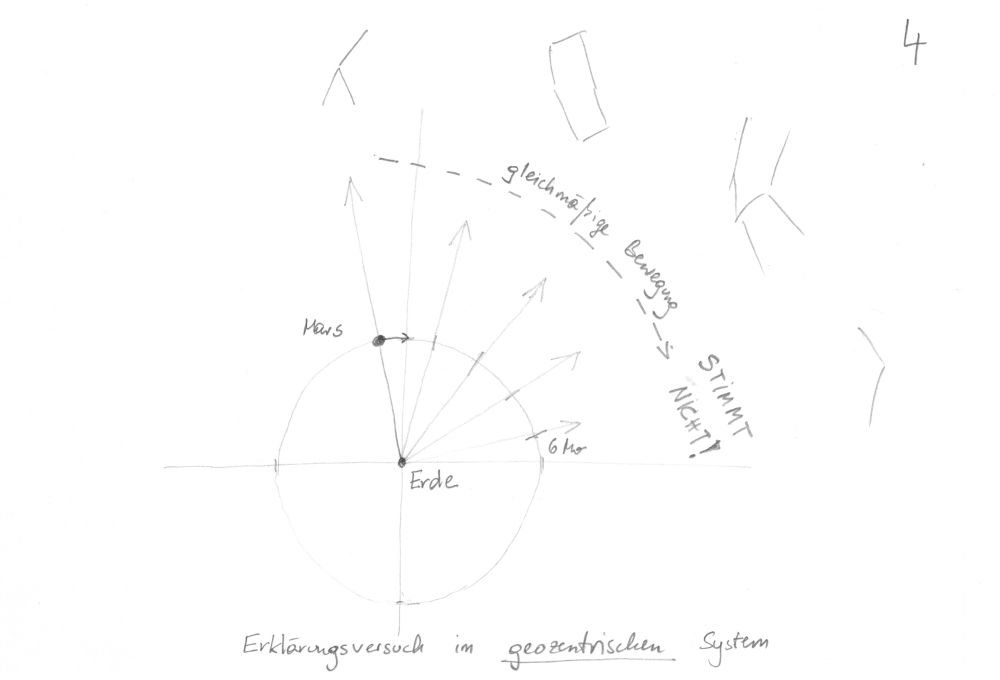
Wenn die Erde in der Mitte des Universums wäre und der Mars sie einfach umkreisen würde, dann würde er über die Monate hinweg einfach gleichmäßig an den Sternbildern vorbeiziehen, und es gäbe keine Rückwärtsbewegung (der Fachausdruck dafür ist übrigens "retrograde Bewegung", damit ich das auch noch erwähne). So einfach wie im folgenden Diagramm kann es also nicht sein:
(Klick auf meine Zeichnungen öffnet wieder etwas größere Darstellungen)


Dieses Problem repariert nun das – eigentlich schon geniale und erst 1500 Jahre später als falsch erwiesene – Konzept, das Ptolemäus in seinem Handbuch beschreibt (ob es von ihm selbst ist, ist nicht klar; vermutlich kam die Idee schon früher auf):

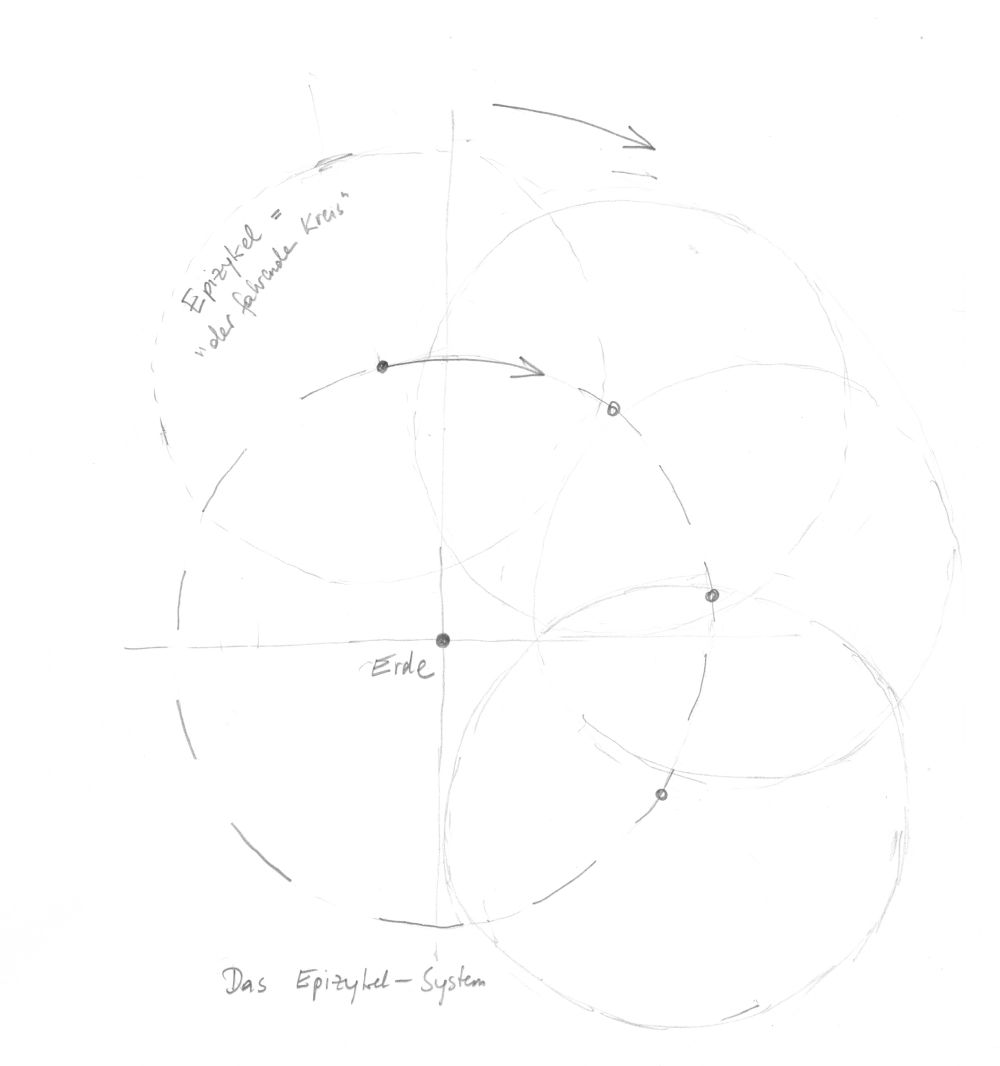
Man lässt nicht den Planeten selbst im Kreis laufen, sondern einen weiteren Kreis, auf dem dann der Planet – etwa der Mars – sich bewegt. Hier ist einmal eine Zeichnung nur vom "fahrenden Kreis", dem "Epizykel". Sein Mittelpunkt (der kleine Kringel) bewegt sich gleichmäßig auf dem strichlierten Kreis im Uhrzeigersinn um die Erde, also den (angenommenen) Mittelpunkt des Universums:


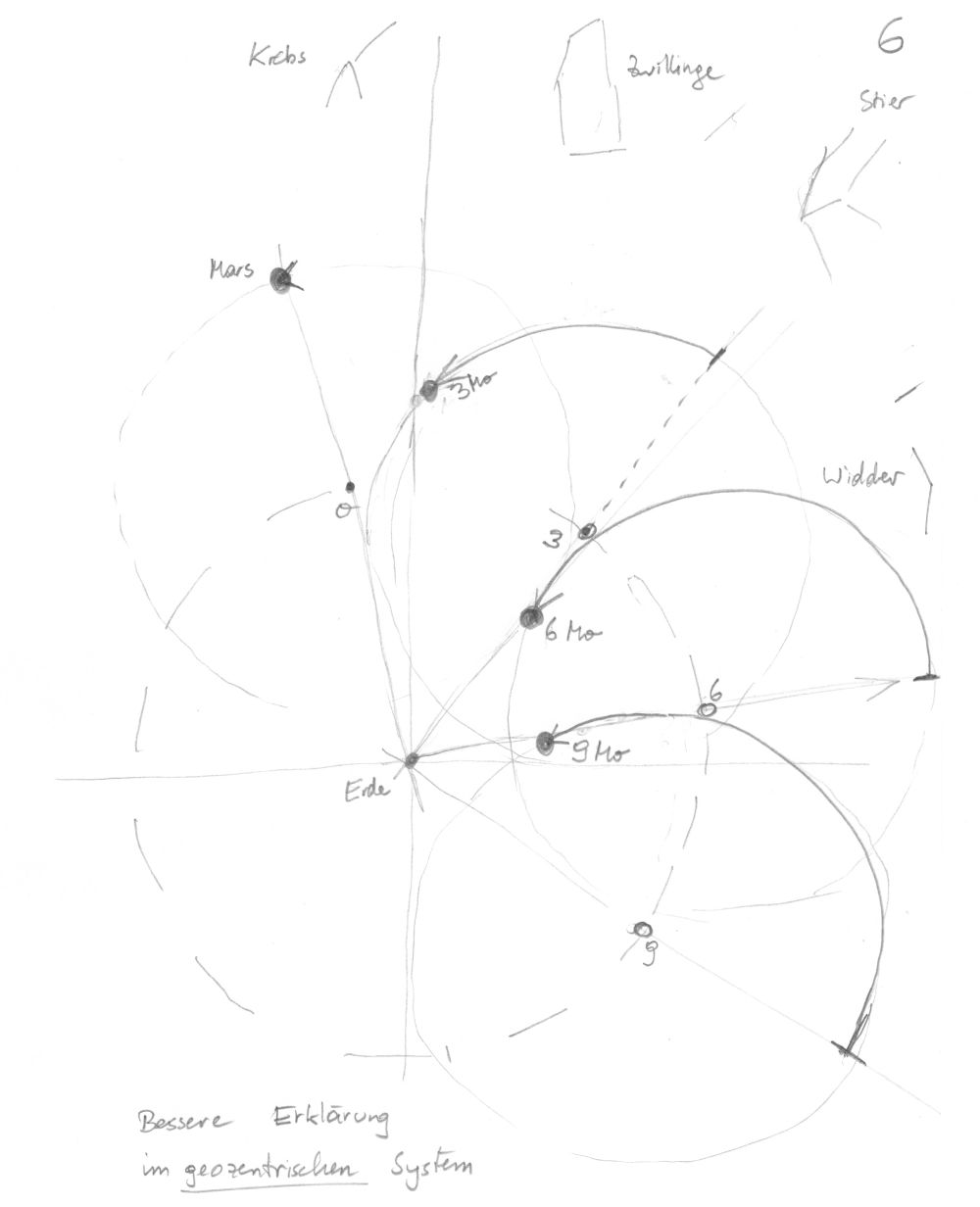
Auf dem Epizykel läuft nun mit einer anderen Geschwindigkeit der Mars in der Gegenrichtung um. Die Position des Mars und damit seine sichtbare Richtung ist damit die Summe aus zwei Kreisbewegungen, und damit kriegt man ganz gut die Schleifenbewegung am Himmel hin. Man kann damit die "Heiligkeit der Kreise" erhalten, aber trotzdem die Hin- und Herbewegung der Planeten halbwegs erklären. Hier ist ein Bild, dass das versucht:


  • In der ersten Stellung des Epizykels befindet sich der Mars von der Erde aus gesehen in gerader Verlängerung hinter dessen Mittelpnkt (bei dem kleinen o) und ist damit im Krebs sichtbar.
  • Drei Monate später hat sich der Epizykel um 45° weiterbewegt; aber zugleich hat sich der Mars auf dem Epizykel in der Gegenrichtung bewegt (der dunkle Pfeil am Epizykel), und daher steht der Mars nun nur ein kleines Stück weiter.
  • Nach 6 Monaten ist Epizykel wieder 45° weiter, aber der Mars beginnt nun auf seiner "Unterseite" sich in die gleiche Richtung zu bewegen. Daher sieht es so aus, als würde er beschleunigen – wie auch bei der richtigen Erklärung.
  • Bei 9 Monaten ist der Mars schon viel weiter fast am Widder vorbei.
Die eigentliche Schleife nach 1 1/2 Monaten habe ich in dem Bild unterschlagen – erstens, weil es dann vor lauter Kreisen nur so wimmeln würde; aber zweitens auch, weil ich eine wirklich korrekte Beschreibung der Planetenbahn damit nicht hinbekommen habe. Und das ist auch Problem der Epizykel-Theorie: Je genauer man die Planetenbahnen vermisst, desto mehr merkt man, dass man die Kreiskonstruktion nicht so hinbekommt, dass sie genau die reale Bewegung beschreibt.

Man hat das, rund um Galileis Zeiten, mit noch komplizierteren Konstruktionen zu "reparieren" versucht. Zum Beispiel gab es Vorschläge, wo sich auf dem Epizykel nicht der Planet, sondern ein weiterer Epizykel bewegte – also drei "gestaffelte Kreise". Die Bestimmung der Radien und der Geschwindigkeiten der Kreise, damit alles stimmt, wird dann zu einem ziemlich mörderischen mathematischen Problem. Trotzdem muss man feststellen, dass zum Beispiel der geniale Galilei selbst nie die kreisförmige Bewegung bezweifelt hat und die (korrekten) keplerschen Ellipsen ablehnte. Kreise wirken auf uns Menschen offenbar so "schön" und "elegant" (und "göttlich"?), dass wir sie auch in der Natur unbedingt wiederfinden wollen.

Als zu Keplers Zeiten dann aber mit Fernrohren (Kepler und Galilei haben zu ihrer Entwicklung beigetragen) und immer genaueren feinmechanischen Messinstrumenten (die auch aufgrund der Fortschritte im Bau von Uhren möglich wurden) die Bestimmung der Planetenpositionen immer präziser wurde, konnte man die Abweichungen zur Epizykeltheorie nicht mehr länger "zukleistern"; und mit den Keplerschen Gesetzen (und dann 70 Jahre später ihrer Verallgemeinerung durch Isaac Newton) stand eine perfekte Theorie der Planetenbahnen zur Verfügung, die die ältere Theorie dann sozusagen umbrachte.

Dass sich die katholische Kirche (und nicht nur sie) noch lange Zeit dagegen gewehrt hat, die Erde aus dem Mittelpunkt des Universums zu verbannen, hat die Astronomen nicht mehr interessiert. Viele anderen aber taten – und tun – sich wohl sehr schwer damit, dass der "Planet des Menschen" diese Mitte verlassen musste und er und damit wir alle "nur ein Staubkorn im Universum" sind: Das ist ja diese grundsätzliche "kopernikanische Wende", die sich da zu Beginn der Neuzeit abspielt. Und umgekehrt gesehen bedeutet das, dass sich die Philosophie und Wissenschaft bis dorthin eben doch (auch) dadurch charakterisieren lässt, dass der Mensch unhinterfragt immer im Mittelpunkt stand.

Ein letztes Mal musste übrigens auch die bessere, kepler'sche oder newton'sche Theorie korrigiert werden, als 1915 Einstein in seiner allgemeinen Relativitätstheorie eine minimal andere Bewegung der Planeten berechnen konnte, die die – damals messbaren – kleinen Abweichungen der realen Plantenbewegung gegenüber Newtons Vorhersagen auch erklären konnte. Seither ist das Thema der Planetenbewegung kein Streitfall mehr.

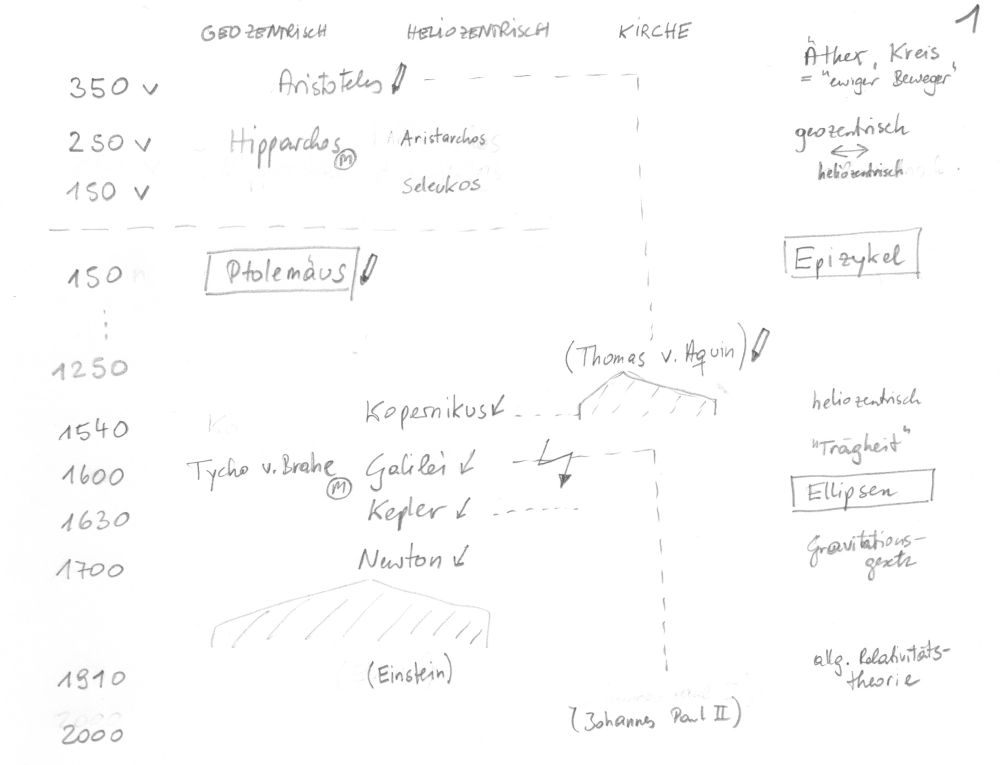
Ach ja – was hat Johannes Paul II. in der geschichtlichen Übersicht ganz am Anfang verloren? Nun, er hat immerhin die Kommission der katholischen Kirche einberufen, die nach 400 Jahren die Verurteilung Galileis als Fehlurteil anerkannt kann. Auch ein (kleiner) Fortschritt.

Das Problem, das die Epizykeltheorie lösen will

Planeten


Wenn man den Himmel betrachtet, dann sieht man Sternbilder: Das bedeutet, dass die Sterne relativ zueinander "festgenagelt" sind. Nun dreht sich zwar der ganze Himmel um die Erde (oder, wie wir's heute sehen, die Erde um sich), insoferne sind die Sterne nicht "fest". Aber sie bleiben zueinander fix, wie auf ein Gemälde gemalt.

Aber ganz stimmt das nicht: Es gibt nämlich (genau) sieben Ausnahmen, die man mit freiem Auge sehen kann (wenn man von scheinbar oder tatsächlich zufälligen Ereignissen wie Kometen, aber auch Sternschnuppen absieht).
  • Die bekannteste davon ist der Mond – er steht jeden Tag (oder eigentlich jede Nacht) "woanders" auf dem Gemälde.
  • Eine zweite ist die Sonne – die ist zwar so hell, dass sie alle Sterne überstrahlt, insofern kann man nicht sehen, dass sie sich gegen die Sterne bewegt. Aber wenn man in der Morgendämmerung schaut, wo die Sternbilder stehen, und das zur aufgehenden Sonne in Beziehung setzt, dann sieht man, dass die Sonne da auch jeden Tag woanders ist; immer nach einem ganzen Jahr ist sie allerdings wieder an derselben Stelle des Sternenhimmels.
  • Und dann gibt es noch fünf Sterne, die uns (oder unseren Vorfahren, die sich dafür interessiert haben), Kopfzerbrechen machten, weil sie nicht wie die Tausenden anderen Sterne fest am Himmelsgemälde blieben, sondern sich darin herumbewegten: Auch so langsam wie die Sonne oder noch etwas langsamer, sodass es ein oder mehrere Jahre brauchte, bis sie wieder an derselben Stelle waren.
Diese sieben Himmelskörper nannte man "Planeten" (von griechisch planaomai, was ungefähr "herumschweifen" bedeutet – habe ich nachgeschaut), und die fünf davon, die Sterne waren, bekamen die Namen Merkur, Venus, Mars, Jupiter und Saturn – wobei man nur die mittleren drei deutlich und hell sieht. Warum diese fünf Sterne so "herumfuhren", das haben sich manche Leute gefragt.
(Anmerkung: Heute zählt man Sonne und Mond nicht mehr zu den Planeten – da hat sich der Sprachgebrauch geändert).

Ich erkläre das nun in historisch verkehrter Reihenfolge: Also zuerst "richtig" – so wir heute das verstehen. Das ist auch schon etwas vertrackt, aber nur so kann man es überhaupt verstehen. Danach erkläre ich dann, was sich Ptolemäus ausgedacht hat – eben die Epizykeltheorie.

Die Schleifenbewegung


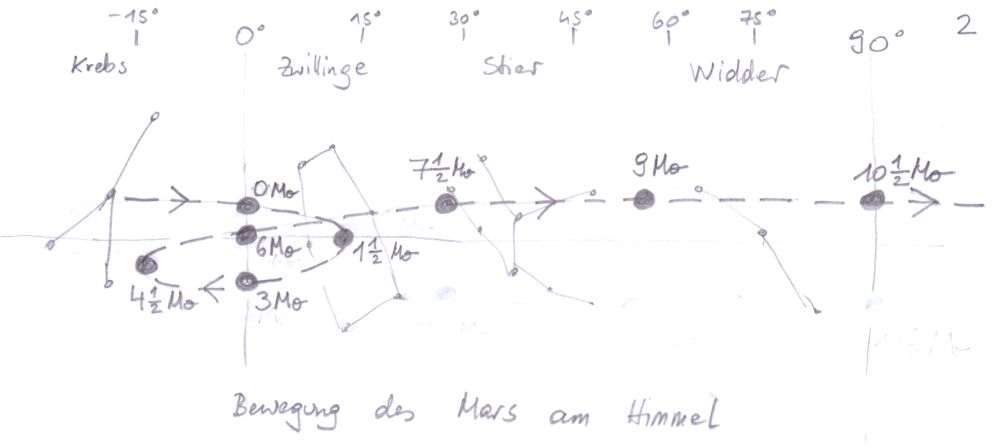
Zuerst einmal habe ich – siehe das nächste Bild – die Bahn des Mars aufgezeichnet, wie sie in irgendeinem Jahr aussehen könnte. Der Mars zieht hier an vier Sternbildern vorbei, die sich über dem Erdäquator befinden, sodass man sie bei uns nur im Sommer ziemlich im Süden sehen kann: Krebs, Zwillinge, Stier und Widder. Der schwarze Kreis ist der Mars, und neben den eingezeichneten Positionen steht die Zeit in Monaten: Zu irgendeinem Zeitpunkt (bei 0 Mo) steht er also zwischen Krebs und Zwillingen, dann geht er ein wenig in die Zwillinge hinein, ist nach drei Monaten (bei 3 Mo) wieder fast zurück, fährt dann in den Krebs, ist dann wieder zwischen den beiden, und dann gibt er plötzlich Gas und fährt immer schneller über Stier (7 1/2 Mo) zu Widder und weiter. Es dauert dann ungefähr noch ein Jahr (also insgesamt etwa zwei Jahre), und dann ist er wieder in der Krebs-Gegend. Ziemlich komisch, das Ganze, oder?
Oben über der Zeichnung sind noch Gradzahlen angegeben, die die Position am Himmel anzeigen: Wenn wir also zum Beispiel den Krebs gerade genau im Süden sehen, dann ist der Widder um 90° versetzt dazu, also grade am Horizont zu erkennen.
(Ein Klick auf die Zeichnung öffnet eine größere Version davon, zum Abspeichern oder zumindest genauerem Studieren)


(Mir fällt grad auf, dass es sein könnte, dass ich mich in der Richtung vertan habe und der Mars sich in umgekehrter Richtung bewegt und/oder die Sternbilder umgekehrt sortiert sind... dann tut's mir leid, und ihr müsst euch denken, dass die Sternbilder oben umgekehrt angeordnet sind). Dass der Mars hier eine richtige Schleife macht, also nicht nur hin und her, sondern auch ein wenig auf und ab geht, interessiert uns hier übrigens nicht: Das hat seinen Grund nur darin, dass Erdbahn und Marsbahn ein wenig schief zueinanderliegen. Was aber jede Theorie der Planetenbewegung sauber erklären muss – sei's die moderne, sei's die Epizykeltheorie –, ist eben dieses ziemlich weite Hin- und Herfahren zwischen den Sternbildern.

Die richtige Erklärung


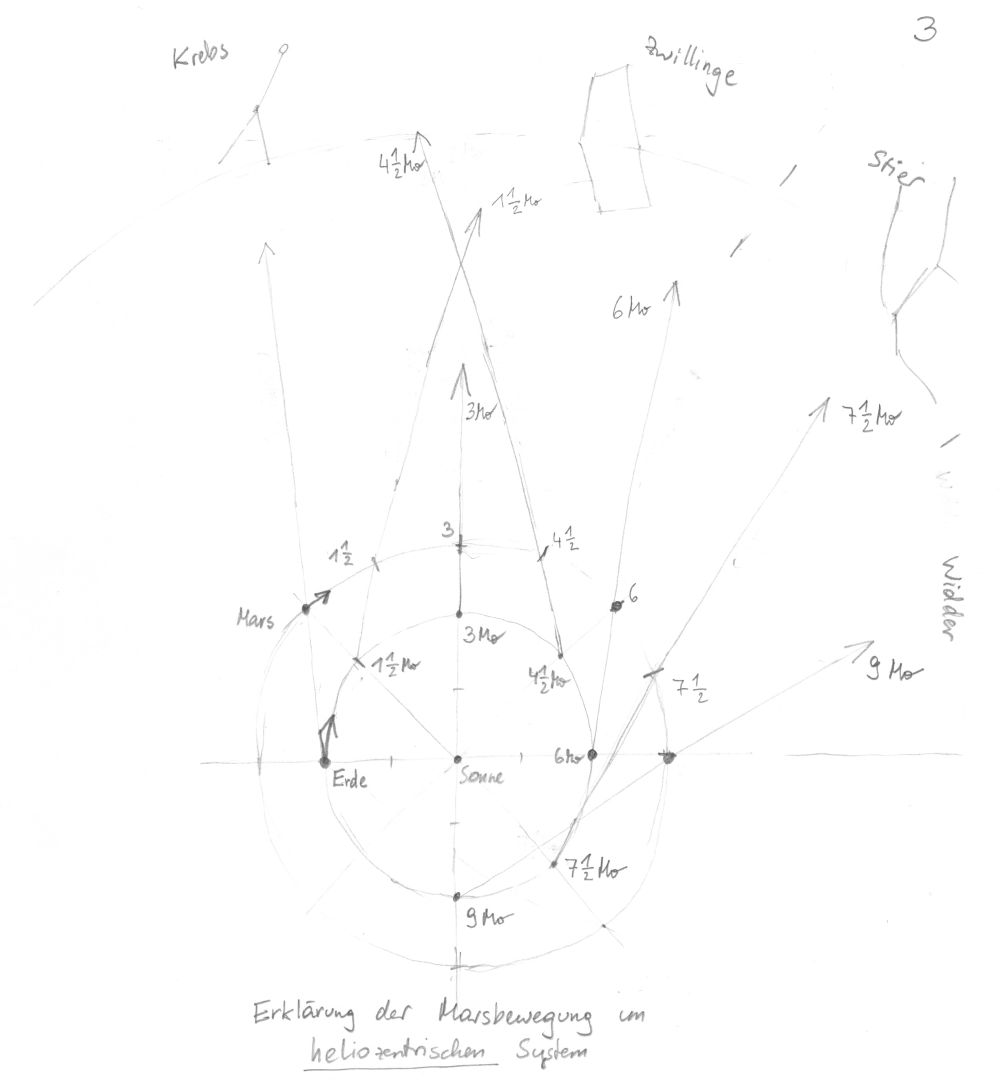
Was passiert da? Hier ist eine Zeichnung, die dieses Phänomen erklären soll – die Details kommen gleich drunter im Text:
(Wieder kann man auf die Zeichnung für eine größere Darstellung draufklicken)


Zur Erkärung: Unten in der Zeichnung sehen wir das Sonnensystem, von oben betrachtet:
  • In der Mitte ist die Sonne,
  • die Erde dreht sich um sie im Kreis
  • und ein Stück weiter außen der Mars.
Die Distanzverhältnisse sind übrigens ziemlich korrekt abgebildet: Der Mars ist etwa 50% weiter von der Sonne als die Erde.
Ganz weit weg ist oben noch die "Himmelskugel" abgebildet, auf der sich die Sternbilder mit ihren Sternen befinden – die sind natürlich in Wirklichkeit nicht "auf der Himmelskugel", sondern im ganzen Weltall verteilt; aber sie sind alle so weit weg, dass ihre Distanzunterschiede vollkommen egal sind.

Bei Erde und Mars ist nun ihre Bewegung eingezeichnet:
  • Die Erde lasse ich im "Monat 0" links "losfahren", und weil sie ja in einem Jahr, also 12 Monaten einmal um die Sonne läuft, ist sie nach 1 1/2 Monaten um 45° weiter auf ihrem Kreis; nach drei Monaten um 90° weiter; nach 6 Monaten um 180° weiter; usw.usf.
  • Den Mars lasse ich (einfach so – ist halt zufällig grad so – nein, habe ich mir aus Zeichnungsgründen so ausgesucht) links oben losfahren. Nun braucht der Mars aber fast zwei Jahre um die Sonne (das ergibt aus dem 3. Keplerschen Gesetz – erkläre ich hier nicht), daher ist er nach 1 1/2 Monaten nicht um 45° weiter, sondern nur um die Hälfte. Und erst nach 3 Monaten hat er die 45° geschafft, nach 6 Monaten ist er um 90° weiter – also nun "rechts oben" usw.usf.
(Das muss einem unbedingt klar sein – sonst versteht man den Rest nicht ... ist es klar? Wenn nicht, nocheinmal Zeichnung anschauen und Text lesen!).

Und nun stellen wir uns "oben" auf unsere kleine Erde und schauen zum Mars. Wo sehen wir ihn?
  • Zum Zeitpunkt 0, also dem Beginn unserer Beobachtung, steht er vor den Sternen des Krebs – am Himmel, wo wir mit freiem Auge keine Distanzen schätzen können, steht er also "im Krebs".
  • 1 1/2 Monate später hat er sich ein Stück weiterbewegt, bis zu dem ersten Querstrich; und die Erde "läuft ihm auf ihrem Kreis hinterher". Wenn man sich wieder ansieht, wo man ihn nun jetzt sieht, dann steht er ein Stück weiter, nämlich links vor den Zwillingen; oder am Himmel eben "in den Zwillingen".
  • Noch eineinhalb Monate später, also nach 3 Monaten "überholt" ihn nun aber die Erde – nicht, weil sie schneller wird, sondern einfach, weil sie auf ihrem kleineren Kreis eben "enger um die Kurve flitzt". Wenn man wieder die Richtung von Erde (wir) zu Mars einzeichnet, dann zeigt sie nun zwischen Krebs und Zwillinge – der Mars hat sich also am Himmel scheinbar von den Zwillingen aus zurückbewegt! – da haben wir schon das Schleifenphänomen! Aber weiter:
  • Nach 4 1/2 Monaten hat ihn die Erde noch ein Stück weiter überholt, und der Pfeil Erde→Mars zeigt nun fast parallel zu dem Sichtpfeil zum Zeitpunkt 0. Der Mars ist nun also wieder vor dem Krebs zu sehen.
  • Nach 6 Monaten "biegt" die Erde nun aber schon stark "nach unten" ab, und der Mars kann sie nun seinerseits "überholen": Der Pfeil Erde→Mars zeigt nun schon eher rechts in die Zwillinge, der Mars ist also "an den Zwillingen vorbei".
  • Und nach 7 1/2 Monaten bewegt sich die Erde schon im unteren Teil ihres Kreises nach links, während der Mars noch auf seiner Kreis-Reise nach rechts ist: Die Sichtlinie von der Erde zum Mars zeigt nun schon zum Stier, der Mars "steht im Stier".
  • Noch eineinhalb Monate später, also nach 9 Monaten, ist die Erde ganz unten, der Mars ganz rechts, und die Sichtlinie zeigt in den Widder.
  • usw.usf.
Man sieht also, dass die "komische Schleifenbewegung" des Mars aus dem Zusammenwirken der zwei ganz einfachen Kreisbewegungen von Erde und Mars samt der Distanz zwischen ihnen entsteht – eigentlich nicht schwierig, aber man muss eben diese Sicht auf die Dinge haben; und sich das schon einmal im Detail genau überlegen (die Zeichnung hat mich fast eine Stunde gekostet, bis das alles so ungefähr dort war, wo es sein sollte).

So ist das also mit der richtigen Erklärung der Marsbewegung – und die anderen Planeten machen es ebenso, nur mit anderen Umlaufzeiten und Abständen.

Was aber dachte sich Ptolemäus – und musste sich denken, weil er die Erde partout im Mittelpunkt des Universums ansiedeln wollte? Dazu mehr im nächsten (und letzten) Posting zu diesem Thema!

Die Epizykeltheorie des Ptolemäus - (m)ein Überblick

An der Epizykeltheorie lässt sich, wenn man so will, "Aufstieg und Fall der ganzen Menschheit" erklären – weil man daran ganz wichtige Aspekte unseres Umgehens mit Problemen sieht. Ok, das mag jetzt übertrieben sein: Aber einiges an Wahrheit steckt schon darin. Bevor ich (hoffentlich verständlich) zu erklären versuche, was die Epizykeltheorie ist, will ich sie daher in den "ganz großen historischen Kontext" einbetten.

Noch eine Vorbemerkung: Alles, was ich erkläre, ist faktisch ziemlich sicher ziemlich richtig – dazu habe ich in den letzen 40 Jahren genügend darüber gelesen (allerdings finde ich heute die Literatur, wo das alles drinsteht, nicht mehr in unseren Büchermassen). Andererseits ist das natürlich alles meine Strukturierung der und Sicht auf die Zusammenhänge – und da kann (und sollte) man sicher viel daran aussetzen, vor allem wenn's um Geschichtliches geht.

Aber fangen wir an. Hier ist ein handgeschriebener Überblick über die Zeiten (links), Personen (Mitte) und die Themen (rechts), die die Epizykeltheorie auf die eine oder andere Art verknüpft:


Die erste Geburt der Naturwissenschaften ...


Auf den ersten Blick fällt auf, dass sich die Zeiten in zwei Bereichen "zusammenballen": Einmal, etwas weniger im Altertum von 350 v.Chr. bis 150 n.Chr.; und dann wieder, viel extremer, von 1540 bis 1700. Diese beiden historischen Abschnitte sind, aus unserer Sicht von "hinten", die zwei "Geburtsstunden der (Natur-)Wissenschaft": Einmal gab im hellenistischen Bereich offenbar das erste Mal eine kritische Menge von Personen (wenn auch verteilt über ein paar Jahrhunderte), die grundlegend die "Probleme der Welt" angehen und lösen wollen – "alles" will man verstehen, nichts soll "einfach so hingenommen werden". Die Zahl der Themen, die man (z.B. Aristoteles) damit aufreißt, ist enorm: Das Leben will man verstehen, das Universum, die Menschen, die Geschichte, wie und wieso sich alles bewegt, die Vielfalt von allem, aber auch wieso manches so gleich ist, und wie das alles mit den überkommenen Vorstellungen von Göttern und Ahnen zusammenhängt. Und weil Menschen damals genauso intelligent wie heute waren, wurden von diesen ersten "systematisch neugierigen Menschen" – was man heute "Wissenschaftler" nennen würde – unzählige Erkenntnisse gewonnen, und unzählige davon waren richtig. Ich kenne mich nur halbwegs in der Astronomie und Physik aus – aber damals wurde z.B. der Erdumfang i.w. korrekt berechnet oder auch die Mindestgröße von Mond und Sonne (allerdings war die Sonnengröße um einen Faktor von 20 zu klein – aber es war ja eine Mindestabschätzung, insofern war das Ergebnis völlig korrekt), und es gab einzelne (Aristarchos und Seleukos), die erklären konnten, wieso höchstwahrscheinlich die Erde um die Sonne kreist und nicht – wie es für uns auf der Erde aussieht – umgekehrt. Das Letztere war allerdings doch so vage argumentiert, dass praktisch alle anderen, die das interessiert hat, sich dagegen aussprachen, und so blieb allgemein – eben auch in Wissenschaftskreisen – die "vernünftig-normale Annahme" akzeptiert, dass Sonne und Mond und Sterne um die Erde kreisen. Deswegen habe ich die zwei auch nur klein hingeschrieben.

Noch was ist wichtig, damals und später: Die "Wirkungsgeschichte" von Personen und ihren Ideen hängt mit der Art der Verbreitung zusammen: Es ist halt so, dass im Großen und Ganzen die, die viel schreiben, mehr bewirken als die, die nur reden – denn Schriftliches kann man nicht nur zu Lebzeiten des Denkers, sondern auch die Jahrhunderte danach aufnehmen, besprechen und kritisieren. Bei den Personen in meiner Liste habe ich Stifte danebengemalt, wenn sie "unermüdliche Schreiber über vieles waren", insbesondere wenn sie sich als "Enzyklopädisten" verstanden, also als Leute, die "alles und jedes" aufschreiben wollten. Die Enzyklopädien oder Lexika, die auf diese Art entstehen, werden zwar in Fachkreisen gar nicht so schnell als Wahrheit anerkannt – die drei in meiner Liste, insbesondere auch Aristoteles, wurden offenbar über Jahrhunderte hinweg massiv kritisiert: Aber im Lauf der Zeit "gewinnen" solche Werke doch öfter gegen verteilte Einzelveröffentlichungen, weil sie eben so "großmächtig" sind (denke ich mir, in einer Art "Küchenphilosophie der Wirkung").

Speziell hatten die zwei Enzyklopädisten Aristoteles und Ptolemäus im Altertum gar nicht das große Ansehen (Platon wurde im Großen und Ganzen bevorzugt; und Ptolemäus war schon "spät dran" und nur für die naturwissenschaftlichen Spezialgebiete relevant); aber im Spätmittelalter waren sie dann doch groß da.

Bei Aristoteles (und wohl bei anderen) stand nun etwas ganz Wichtiges für die Epizykeltheorie, nämlich: Er machte sich Gedanken (ich möchte nicht sagen "er erdachte Theorien" – dazu ist das ganze zu vage) über Elemente und Bewegung, die sich – in Bezug auf unser Thema – so zusammenfassen lassen:
  • Auf der Erde gibt es vier Elemente, nämlich Feuer, Wasser, Erde und Luft (ja, daher kommt das).
  • Im Himmel aber – und nur dort – gibt es ein eigenes fünftes Element, den "Äther", und der bewegt sich auf Kreisbahnen; "weil der Kreis in seiner überall mit sich selbst gleichen Form die göttlichste Form ist" – nicht wirklich ein Argument, aber wenn man's glauben will ...
Das führte dazu, dass man es als selbstverständlich ansah, dass alle Himmelskörper sich auf Kreisen bewegen müssen (erst Johannes Kepler hat 2000 Jahre später, in einem 20 Jahre langen Nachdenk- und Rechenprozess, diese "Selbstverständlichkeit" über Bord geworfen).
Und Ptolemäus macht sich nun daran, mit Kreisen die Bewegung bestimmter Himmelskörper zu erklären – mehr dazu später im "fachlichen Teil".

... und die zweite (Geburt der Naturwissenschaften)


Historisch ist die Geschichte für uns so interessant, weil ... zuerst einmal nicht viel passiert. Ptolemäus lebt in der hellenistischen späteren Antike und schreibt da seine Enzyklopädie. Im Gegensatz zu dem, was einem in der Schule vermittelt wird, hört die "Zeit der Griechen" nicht mit den Römern auf, sondern die hellenistische Kultur und insbesondere Wissenschaftskultur bleibt rund um das Mittelmeer bis 600 nach Christus und danach, in sozusagen zwiegespaltener Form, im oströmischen Reich und bei den Arabern weiter als eine Art "unsichtbares Fundament" bestehen.

1000 Jahre später allerdings beginnt eine neue Zeit anzubrechen: Irgendwas ist zu der Zeit offenbar in der christlichen Kirche passiert – es setzt eine Art Unruhe ein (oder nimmt zu), in der die Diskussionen über das "Richtige und Wahre" um sich greifen – was einerseits die Debattenkultur anfeuert, aber andererseits dazu führt, dass "endgültige Entscheidungen" fallen: Und eine dieser Entscheidungen ist, dass (damals erst) Aristoteles – mittelbar durch Thomas von Aquin – zum "Fachthemen-Heiligen" der Kirche wird, dem man praktisch wie der Bibel zubilligt, dass er (oder eigentlich das, was von ihm tradiert und interpretiert wurde) nur die Wahrheit spricht. Und wegen dessen "Heiligsprechung des Kreises" – wenn ich das so nennen darf – auf der einen Seite, der selbstverständlichen und noch dazu religiös untermauerten Annahme der Erde im Mittelpunkt des Universums (wieso hätte sonst Gott seinen Sohn ausgerechnet auf die Erde schicken sollen?!) andererseits wird nun indirekt Ptolemäus' Epizykeltheorie "heilig", kann also nicht mehr als eine Theorie mit Alternativen diskutiert werden.

Nur leider – die Epizykeltheorie funktioniert nicht.

Das stellt sich um 1600 heraus, z.B. als Tyho v. Brahe, der etwas jähzornige genialste Astronom seiner Zeit, die Messgenauigkeit von Sternenorten auf die Spitze dessen treibt, was man ohne Fernrohre (die um diese Zeit erst erfunden werden) erreichen kann. In den "Rudolfinischen Tabellen" (so genannt nach Kaiser Rudolf II., der Brahe 1599 als Hofmathematiker nach Prag holte) gab er so genaue Koordinaten insbesondere für die Positionen des Mars an, dass klar wurde, dass die alten Theorien falsch sein mussten. Und weil Kopernikus (ein katholischer Bischof!) das heliozentrische System, wo die Erde um die Sonne kreist, in seiner wichtigsten Schrift "wiedererweckt" hatte, gab es nun eine Alternative zur "heiligen Wahrheit".

Der "Showdown" findet in Italien, zwischen Galilei und der katholischen Kirche statt (wobei der damalige Papst und mehrere Kardinäle in weiten Strecken Galilei de facto unterstützten; aber aus politischen Gründen – nämlich dass eben die Lehre der Kirche nicht angezweifelt werden darf – musste Galilei bestraft werden). Galilei und ein anderer Italiener entdecken übrigens die "Venusphasen" (also dass es "volle", "halbe" und "Neu-Venus" gibt wie beim Mond), was ebenfalls die Epizykeltheorie widerlegt – was den beiden auch vollkommen klar ist; aber das ist ein anderes Thema.

Mit diesen Erkenntnissen bricht nun massiv die "zweite Geburtsstunde der Naturwissenschaft" an: Genauere Beobachtungen und vor allem ein parallel zu erfundener mathematischer Apparat – von Kepler und Galilei auf Basis des alten Griechen Euklid begonnen – führen zum ersten Höhepunkt, der Erklärung aller Bewegungen in der Physik durch Isaac Newton. Danach ist die Menschheit von ihrer Annahme, dass sie alles verstehen und erklären könne, nicht mehr zu heilen: Das industrielle Zeitalter bricht an, in dem mit tatkräftiger Mithilfe der Physik und Mathematik alles unternommen wird, was unternommen werden kann: Von der Synthetisierung von Giftgas über die Produktion hunderter Atombomben, die für eine dutzendfache Vernichtung der Erde reichen, bis zur Umwandlung alles tief in der Erde gespeicherten Kohlenstoffs in atmosphärisches Kohlendioxid zum Zwecke der Urlaubsfliegerei und des Klimaanlagenbetriebs, weil uns die Sonne zu heiß ist – und das alles in solchen megalomanen Umfängen, dass es nun heutzutage die Menschheit und die ganze Erde selbst bedroht. Weit haben wir's gebracht – aber das würde nun ein anderes Thema werden.

Ja, aber ... was ist nun die Epizykeltheorie? Hier geht es weiter.

Monday, 2 May 2016

Two SF ideas that certainly have been made to a novel at least twice - but I do not know them

a) The two really different civilizations that find each other at a distance that is conquerable: Say we found that Mars indeed has living "people" on it. When, and how, would we have found out? When Lipperhey invented the telescope, and Galileo looked at Mars? Probably it would have taken a few more years - and it is interesting whether we would have seen them first, or whether we would have shot some probe at them, unsuspecting. And how about the converse? A probe lands nicely on the Earth ...

b) Statistically, we would not meet: One of us would be dead for probably billions of years when the other one came around. What happens?--in detail, I mean. There are many SF novels where people stumble on other planets with crumbling pillars. But we will never go to other planets--we will only send probes. So what happens when that first Russian probe crashes onto Mars and, during its fall, makes a few pictures of something which looks too controlled to be "nature"? Or would that happen--would a probe that falls on Earth see anything human? Even if that happens by chance, would the second probe see houses, roads, or at least a few rectangular fields? How would those at the other end of the probe think, react, continue?

If someone knows of intelligent novels dealing with such topics, drop me a note! (if you happen to send a probe to this blog, of course--which I do not at all promote, so this might be a sort of self-referential experiment, wouldn't it?)

The un/reasonable in/effectiveness of mathematics

To be read, and commented:
There is no good reason to believe that mathematics is always, and easily, effective.

However, there is one thing that is really interesting: That the gravitational law is a simple square law. Why is it so that one of the easier observable patterns in this world--namely, how the moon and the planets move; it is at least so easy to observe that to our knowledge, "all people at every time and everywhere have noticed it"--can be described by mathematics which is easy to learn and seems to have been part of the earliest mathematics we know about--there are quadratic equations in very old Egyptian and Babylonian texts--, and which we can teach to all children?

There are other parts of physics that require wildly more complicated mathematics: Maxwell's laws (vector analysis), relativity (matrices), quantum physics (complex operators)--but the areas they apply to ("controlled" electricity, in contrast to things like lightning; speeds near the speed of light; effects on the atomic level) are also very hard to observe.

So, the question is: Why happen easily observable things (falling bodies, circling planets) to have easily describable formulas?

One answer: This is so by extreme cherry-picking. Almost all other easily observable things around us do not at all have simple formulas, or mathematical formulas at all that describe them. It is no wonder it took 2000 years from e.g. Aristoteles's attempts to understand the world conceptually ("scientifically") to Galileo and Kepler, who found the first tiny segments of reality that gave simple answers to the question "how?".

Still: It might have been that there is no such segment at all. Or does there have to be some "required simple and observable part" of the world?

Mathematics - a game!

In the spirit of the title of this blog, and as I have too many things I have or want to do, I'll put down here just rough items laying out my line of thought:
  1. In order to show that there is no "reality" behind mathematics, i.e., that mathematical objects are not "real" in any sense that gives them existence independent of human thinkers, I argue that mathematics is practically identical to chess: A set of invented rules, whose consequences we are explore.
  2. This refutes the argument that solely from the way of talking that we "discover" new things in mathematics, it would follow that these things have an independent existence: We also discover new openings in chess, new moves, and new universal truths (like "two rooks and a king can win against a sole king").
  3. Critical thought 1: What about the concepts of "truth" and "proof," which play such an important role in mathematics? I want to argue that "truth of a statement" in math can be handled as "a position can be won" in chess: I.e., as a nontrivial mapping of a complex subset of all possible situations to a two-element set { T, F }. Of course, in chess, there is also a draw, whereas for truth, we typically assume the law of the excluded middle. However, one can either modify chess a little so that every position maps to { W, L }; or one considers non-standard logics in math.
  4. Critical thought 2: Math, as opposed to chess, has a usable mapping to many real-world items and problems: Rational  numbers map nicely to lengths, areas and volumes exist in math as well as in real life etc. So there!--math must be something that is "much more real" than chess. I think this is not true: First, the chess rule set and its consequences is a "theoretical construct" like math, which happily maps to real world chess pieces and boards--with similar problems, e.g., that the mapping is not completely two-way (there is no mapping for pieces that straddle the boundaries of squares etc.). Still, math seems so much more "usable in unexpected ways" than the "chess model," which only maps to "real chess."
  5. Critical thought 3: Chess, or at least chess theory, seems to be simply a subset of mathematics. So it is not really possible to show anything interesting about mathematics by recurring to chess. Hmm. Interesting. I do not at all think that chess is a subset of mathematics; at most, it overlaps with mathematics ... but the arguing gets tricky here.
  6. ...etc.

Saturday, 26 March 2016

Mathematics - a first set of thoughts

Hilary Putnam is dead. I read through the Wikipedia page and found that he has changed his stance on the ontology of mathematics: "How real are mathematical things?"—like integral numbers, real numbers, functions, sets, deduction rules, proofs, whatever? For some reason, this makes me nervous: I thought, first of all, that this question is more or less settled—I might not know the answer, but some great philosophers—like Putnam—certainly did and do. But even if they do not, I thought that the various possible answers are so clearly described that you would not switch from one to the other. Rather, you would hold to one conviction and argue why the other ideas were wrong, or irrelevant, or not sufficient, or deficient in some other way.

And in the first place, I thought that the accepted answer is clearly that mathematical objects are in some sense "real," at least in the (or some) sense that mathematical object are "out there" even if no one is in this world or the whole universe who actually does mathematics: See e.g. Linnebo, Øystein, "Platonism in the Philosophy of Mathematics", The Stanford Encyclopedia of Philosophy (Winter 2013 Edition), Edward N. Zalta (ed.).

But, in the second place, I know that I somehow feel confident that this is not true: That mathematics is a purely human construction, or at least a construction of minds doing mathematics. In other words, there is no mathematics without mathematicians.

This is, altogether, unsatisfactory. I am probably wrong, or vague enough so that my ideas count as wrong—but why? And what is a better answer?

I could set out to find the answer—the answers?—in the books. But I fear that I would quickly lose my own ideas, being overwhelmed by the precise arguments of the professionals. And I am not yet there. I want to know why, and how, I am wrong, not what is right.

So—I'd like to think a little bit on my own, probably with a huge bunch of implicit assumptions, at least some of which might become explicit in this process: And only then see whether this matches with someone else's ideas—and then, ideally, find refutations for these! I do not seem to be too humble, probably.

I start out with realism, about what I think Popper said: The actual material things in this world are real. Many of them (at least all the atoms) were here before the first humans and will be here after all of mankind has gone, for whatever reason. I must be careful here: That things were here does not mean that they were identifiable as things. That it is possible to classify certain of the "things in the world" as being similar, and hence be able to call them atoms, stars, trees, might already be mathematics, at its core. So I should probably rather say: The whole world, the universe was, is, and will be there independently of humans and other beings with a reflective, thinking mind. But actually, this has not solved anything: This universe changes. So even talking about a continuing existence or "behaving" of something that—by being continually there—can be seen as (or thought of?) as being something singular might be doing mathematics. So, what is this "realism" actually?

I did not think I would stumble so early. I thought that I could deal with the physical world in a paragraph or two, and then proceed to mathematics. Great. Should I now consult all the books and papers on realism to find out about how one, and we, and I should think about these "real," "observer-independent" world? Yes, I should. But I don't know where to start, and how to make sure I am not again drowned by other ideas and arguments and refutations.

Clueless.

But there is something (that's my given which I would not want to argue about). And there happens something: Some energy gets transformed—yes, we might call it a lightning stroke or a nerve impulse, but even if we would not categorize it (risk: this is already math), it was there. So I have to talk about it without categorization. I try the concept of a "description": This is some more or less precise notation that can be mapped to that world. And a description of something is "good" or "good enough" if someone else who reads the description will agree that it is a description of what it claims to describe.

Now, I have planted myself deep in a big hole full of shit: I wanted to find out what "real" means as in "something is real if it exists independently of a mindful observer"—and I end up answering this by introducing "more or less" precise "notations" that are "read" by "someone" who "agrees" to a "claim." Absolutely ridiculous, isn't it?

First, yes.

Second, I have not better idea (read the books, someone says—yes, I will, um, soon).

Third, I think I can defend at least a bit of this, at least with my target in mind, namely to show, or at least argue, that mathematics is man-made. See, descriptions, in the sense above, can be taken by suitably capable whatevers and compared to the world. And if many such whatevers do that and will e.g. converge in their predictions of what happens next, this is a good description.

Kuhn, and others, would tell me that "compare" and "converge" and "predict" are totally theory-dependent concepts. For my train of thought, however, I want to believe that they are not "totally arbitrary" in the sense that what in many discourses is "converging" will be "not converging" in ("similarly") many other discourses, but that in "most" discourses the predictions will converge. Maybe, to agree on this, it is also necessary (for the "whatevers" that do the reading and comparing and agreeing) to have the descriptions of what converging means, which again are compared and do converge, and maybe a whole hierarchy of descriptions of comparing and converging is necessary. All this would most probably be doing mathematics—but this is only an accident in my description of "realism"—it has, right now, nothing to do with my target problem of, more or less, how mathematical things come into the world. Rather, I leave it totally to the whatevers to do that as they like, and not think about what they do. But I suppose that they will agree, as we humans do over time.

The important aspect behind this notion of realism is that it is fuzzy: It is enough for me if some descriptions of some events are somewhat good. No more can be hoped for before starting with mathematics: No more is found by us and anyone else when looking into the world. And for at least thousands of years, our ideas about that reality were, for concrete aspects, completely wrong; but many were somewhat ok, and this alone did not keep us from doing math. So, it must be possible to base mathematics, at least as a human activity, on such a shaky and largely wrong view of the world. The question is whether all of mathematics must be based so. I think—or rather: feel—that yes, from these muddy waters, mathematics can be "argued up." But I have to argue this a little more.

I have to think about this.